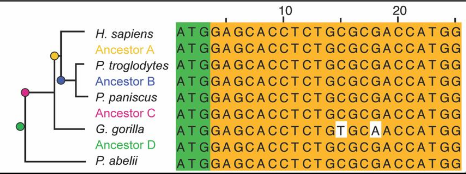
A new paper is out in Genome Biology and Evolution by lab members Lin and Jiwon. This study reconstructs the evolution of orf143, a long de novo human ORF that arose in simians from a noncoding region via a start-codon–creating mutation and was subsequently elongated through stop codon disruption and tandem repeat expansion. The overlap of orf143 with oncogenic binding sites in the lncRNA VPS9D1-AS1 suggests that translation of this de novo ORF may confer a tumor-suppressive selective advantage. This study illustrates how elongation of de novo ORFs may provide a selective advantage. Check out the paper